New Hope Amid Antibiotic Resistance
Antibiotic resistance has turned to a monstrous beast that is difficult to tame in several parts of the world. Researchers at Swansea University have developed a technology that effectively can deconstruct such dangerous bacteria with over 99.9% efficacy. The technology has shown particular efficiency against Pseudomonas aeruginosa.
A New Technological Paradigm-Heteromultivalent Nanogels
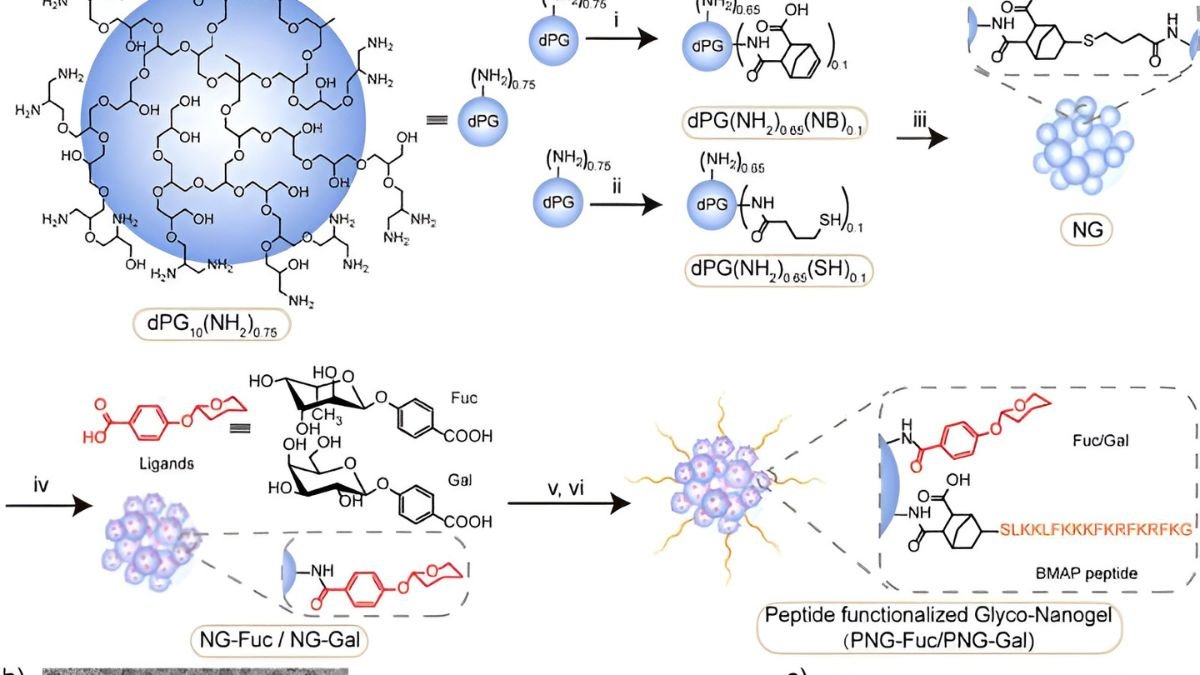
Heteromultivalent nanogels are the stars of this story. They are soft particles formed of an appropriate polymer, sugar residues (e.g., galactose and fucose), and antimicrobial peptides. This work appeared in Angewandte Chemie International Edition.
The sugar component of the nanogel specifically binds to proteins on the surface of the bacteria. Therefore, the nanogel travels straight to the target bacteria, with the peptides disturbing the membrane, quickening its death.
Deep Impacts on Bacteria
The well-advanced study used flow cytometry, scanning electron microscopy, and confocal microscopy.
The tests revealed:
- More than 99.99% destruction of free-floating P. aeruginosa.
- 99.9% elimination of biofilm-covered bacteria in 12 hours.
- Biofilm development is a barricade for bacteria to defend themselves, and disrupting such barriers is normally tough.
Effects on Other Dangerous Bacteria Too
This approach of utilizing nanogels is not restricted to only one bacteria; In vitro tests have also shown its efficacies against other deadly drug-resistant strains like E. coli and MRSA.
This proves that this technology may very well become an effective and versatile option to address various multi-drug-resistant infections.
New Directions for Medicine
Drug resistant bacteria and biofilm-based infections constitute some of the most recalcitrant problems afflicting modern medicine. Therefore, this nanogel technology provides an answer to both problems with an efficient mechanism.
Such therapies can potentially shape the future of treating infections that are otherwise extremely hard to tackle with today’s drugs.
Researchers’ Perspectives
Dr. Sumati Bhatia, Senior Lecturer in the Department of Chemistry at Swansea University, was the lead author and supervisor of the study. She expressed great encouragement with this result. She stated further that this research unlocks new possibilities for glycan-based polymer systems against pathogenic bacteria.
She added that this might provide a pathway towards a new class of antibacterial therapies in the future, especially for infections that are rapidly spreading and becoming increasingly difficult to treat.
The Outcome of Global Collaboration
This is the outcome of a collaboration between researchers at Swansea University and Freie Universität Berlin. This collaboration combined expertise from glycochemistry, polymer science, and nanotechnology to produce this innovative outcome.
